Abstract:
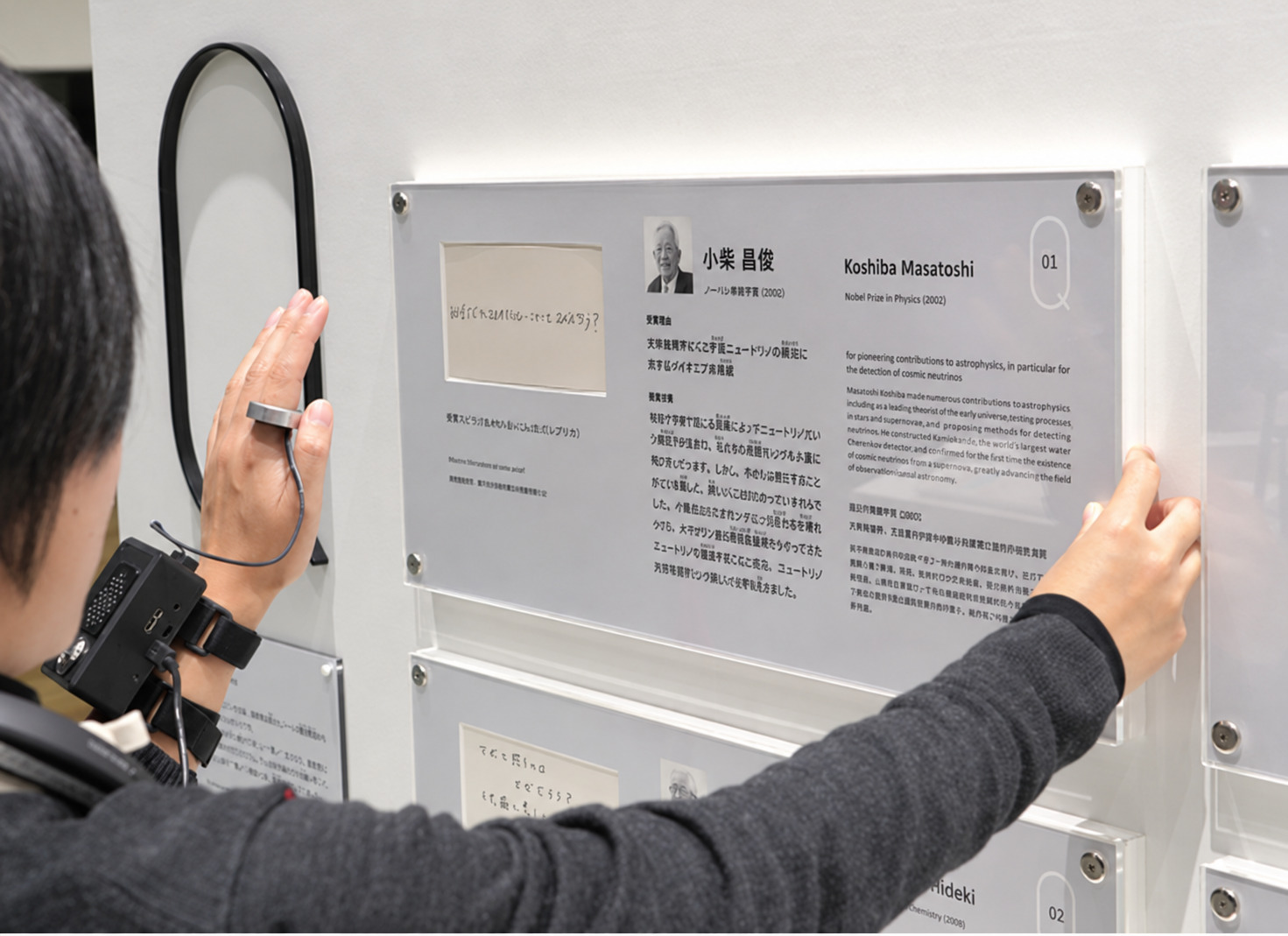
Blind and low vision (BLV) users rely on touch to build spatial understanding of the physical world. However, much information cannot be accessed through touch alone. Camera-based assistive systems help bridge this gap, yet how BLV users coordinate their hands and bodies across tactile and non-tactile media remains unclear.We investigate the spatial interaction strategies that BLV users employ when accessing information through a fnger-worn ring camera. Eleven BLV participants accessed four media that varied in tactile cues through a Wizard-of-Oz system, which delivered information audibly at multiple granularities. Participants consistently used one hand as an anchor while adjusting the camera-wearing hand three-dimensionally, with the anchor serving as both a spatial reference and a postural support. Retrieval spanned scales from torso-level framing to fngertip-level calibration, yet intermediate-range capture remained particularly challenging.We discuss design implications for ring camera-based systems that support BLV users’ spatial interaction with diverse media.
視覚障害者は、物理世界を理解するうえで触覚を重要な手がかりとして利用しています。しかし、現実世界には触れるだけでは得られない情報も多く、カメラを用いた視覚支援システムがその補助として活用されています。一方で、触覚的な手がかりが異なる対象に対して、視覚障害者が手や身体をどのように協調させるのかは十分に明らかになっていません。本研究では、11名の視覚障害者を対象に、指に装着するリング型カメラを用いて、触覚的な手がかりの異なる4種類の対象から情報を取得する際の空間的インタラクションを調査しました。その結果、参加者は一方の手を対象物に置いてアンカーとし、もう一方のカメラ装着手を三次元的に調整していました。アンカーとなる手は、空間的な基準であると同時に、身体姿勢を安定させる役割も果たしていました。また、情報取得では、身体全体を使った大きな位置調整から、指先による細かな位置合わせまで、異なるスケールの動きが用いられていました。
Authors: Ayaka Tsutsui, Xiyue Wang, João Guerreiro, Hironobu Takagi, Yoichi Ochiai and Chieko Asakawa
Paper link: https://dl.acm.org/doi/10.1145/3797867.3828989