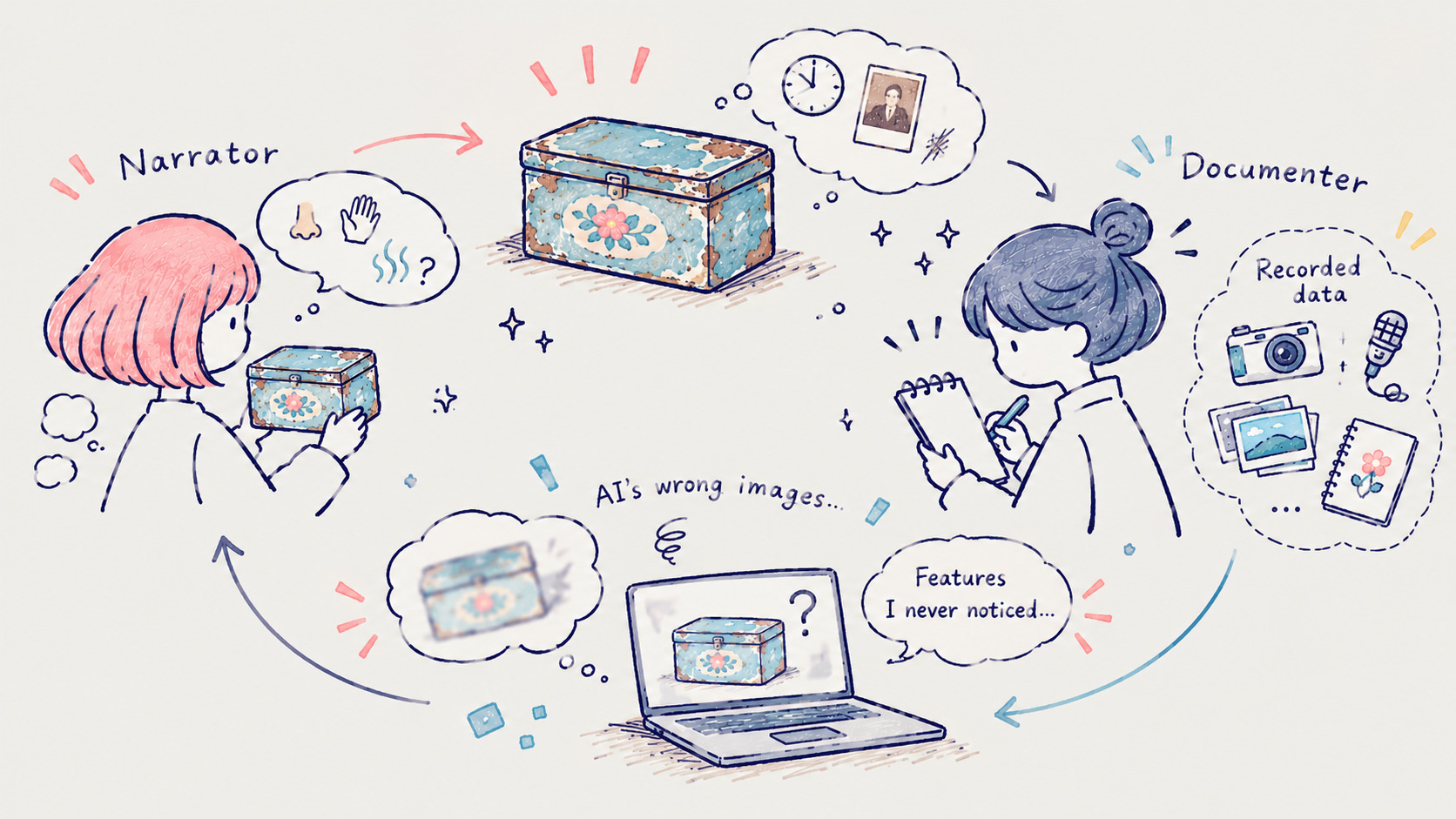
[Abstruct] Cultural records of cherished objects are mostly produced by people who were there: curators, field researchers, family members. These documenters are neither the owners of the memories they record nor strangers to them: they saw the object, heard its owner speak, and produced a record that outlives the encounter. Yet what their own memory adds to and subtracts from the record has not been examined. We investigate this position from the inside. The first author interviewed six private collectors in Tohoku, Japan, about objects they keep, then audited their own memory through a three-layer comparison: memory externalized in writing before any image was seen; renderings by text-to-image models prompted only with the narrator’s transcribed words; and the photographic record, or an empty frame where its publication was withheld. The comparisons were bound into hand-sewn, extra-illustrated booklets and exhibited with a station at which eleven visitors generated and inserted their own imaginings. In our cases, narrated procedure traveled well while material time did not; unwitnessed imagination, human and machine alike, tended to default to the present tense; and, unexpectedly, the machine’s wrong images worked as an elicitation device, prompting the witness to put into words what no earlier record had captured. We offer these observations as exploratory patterns to be tested across further witnesses, objects, and models, not as established properties. We contribute the secondary
witness as a methodological position for cultural computing, the three-layer comparison as a way to audit archives while their witnesses are alive, and a case-grounded account of what survives in which medium of record.
[Authors] Chinatsu Ozawa, Yoichi Ochiai, Masaki Takeda
<概要> 大切にされてきた品々に関する文化的記録は、その場に立ち会った人々――学芸員、フィールド調査研究者、あるいは家族など――によって作成されることが多い。こうした記録者は、記録する記憶の「所有者」ではないが、かといって全くの「他人」というわけでもない。彼らはその品を目にし、持ち主の語りを聞き、その出会いよりも長く残る記録を作り出したのである。しかし、記録者自身の記憶が、その記録に対して何を付け加え、あるいは何を削ぎ落としているのかについては、これまで十分に検討されてこなかった。本研究では、この立ち位置を「内側」から探究する。筆頭著者は、日本の東北地方に住む6名の個人収集家に対し、自身が所有する品々についてインタビューを行った。そして、以下の3つの層を比較することで、記録者自身の記憶を検証した。すなわち、画像を見る前に書き留められた記憶、語り手の言葉のみをプロンプトとして生成された画像(テキストから画像を生成するモデルによるもの)、そして写真記録(あるいは、公開が見送られた場合に生じる「空のフレーム」)である。これらの比較結果は、手縫いで綴じられ、図版を添えた小冊子にまとめられた。展示会場には、来場者が自身の想像を膨らませて記録を追加できるコーナーも設けられ、11名の来場者が参加した。調査の結果、語られた「手順」はうまく伝達される一方、「物質的な時間」はそうではないことが明らかになった。また、人間であれ機械であれ、直接目撃していない想像は、どうしても「現在形」に偏る傾向がある。興味深いことに、機械が生成した「誤った画像」が、語り手から新たな言葉を引き出す触媒として機能した。それまでどの記録にも捉えられていなかった事柄が、この画像を通じて語り手によって言語化されたのである。本稿で提示する知見は、確定した性質としてではなく、今後、他の証言者や対象物、モデルを用いて検証されるべき「探索的なパターン」として提案するものである。我々は、「文化的コンピューティング」における方法論的な立ち位置として「二次的な証言者」という概念を提示し、証言者が存命のうちにアーカイブを検証する手法として「3層比較」を提案する。さらに、どのような記録媒体に何が残るのかについて、具体的な事例に基づいた考察を行う。
[著者] 小澤 知夏(公開時 修士2年),落合 陽一(図書館情報メディア系 教授),武田 将季(図書館情報メディア系 助教)
※本研究は武田将季助教との共同研究として実施し,JSPS科研費JP25K03415の助成を受けたものです。