音波の力で物体に触れずに空中へ浮かせる音響浮遊は、壊れやすい試料や汚染を避けたい材料、危険な物質を扱う手段として期待されてきました。しかし従来の方式は、向かい合う音源や反射板のあいだに定在波を作り、音圧がほぼゼロになる「節」に物体を捕らえるものです。装置に囲われた空間でしか物体を扱えず、囲いのいらない片側照射の方式であっても、保持できるのは音源からわずか数センチの範囲に限られていました。
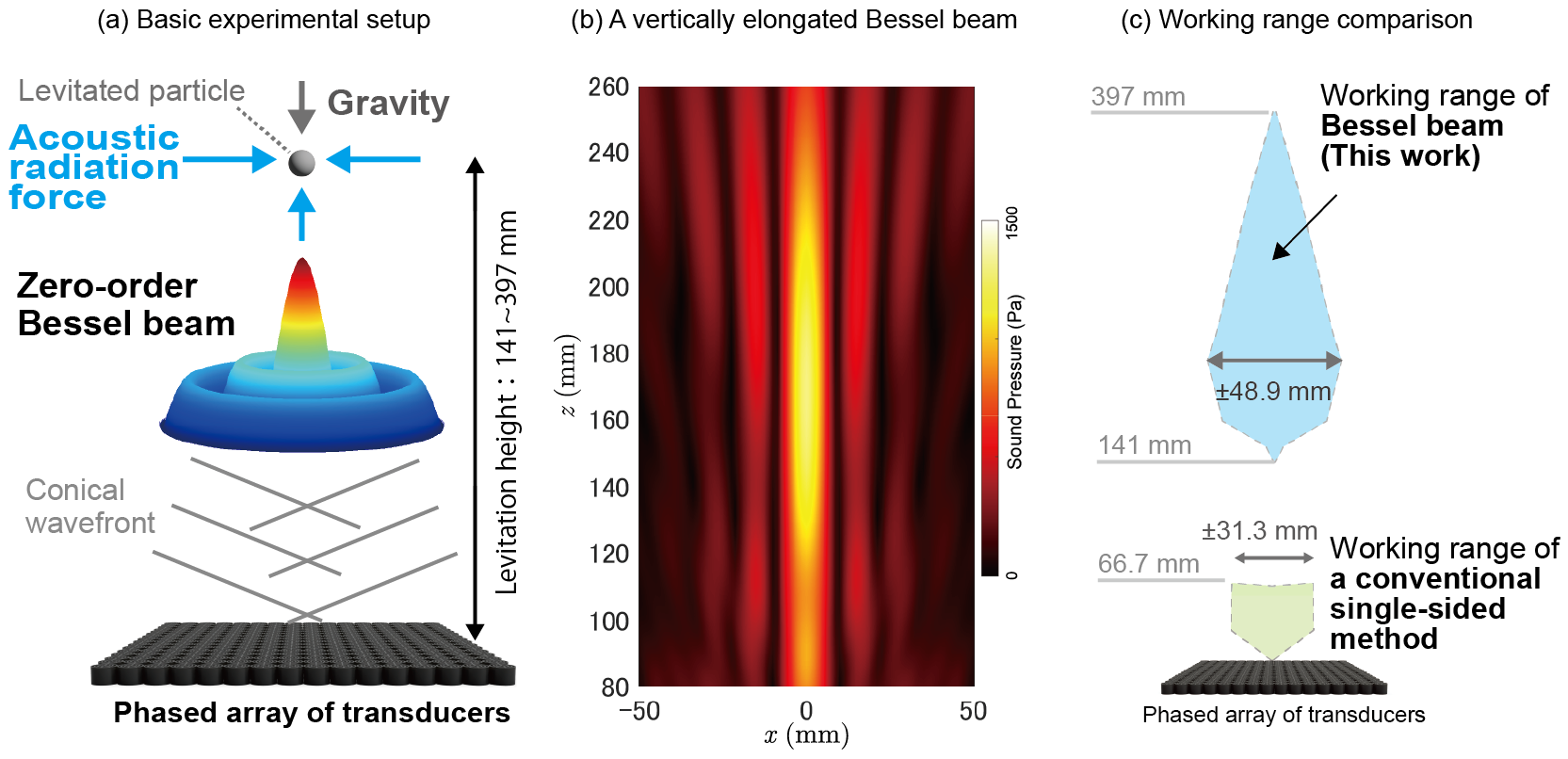
本研究では、物体を捕らえる場所そのものを変えました。中心軸に高い音圧が細く集中したまま遠くまで伝わるゼロ次ベッセルビームを片側から照射し、音圧の高い領域で物体を捕らえます。256素子の超音波フェーズドアレイ(40 kHz)を用い、直径1.5 mmの発泡ポリスチレン球を音源から141〜397 mm(従来の約6倍)の範囲で安定に浮遊させ、3次元的に動かすことができました。ビームを分けた複数物体の同時浮遊や、乾燥茶葉・エアロゲル片のような球形でない物体の浮遊、さらにビームの自己修復性によって障害物の先での浮遊も実証しています。装置の囲いと音源の近傍という二つの制約から解かれることで、実験・製造工程の自動化や立体ディスプレイへの応用が期待されます。
A research team at the University of Tsukuba, Pixie Dust Technologies, and the University of Bristol has experimentally demonstrated, for the first time, stable three-dimensional acoustic levitation within the high-pressure core of a zero-order Bessel beam. Using a specially designed ultrasonic beam emitted from a single side, the researchers successfully levitated and translated millimeter-scale objects in midair without physical contact over distances of up to approximately 40 cm. This working distance is approximately six times greater than that achieved using conventional single-sided acoustic levitation methods.
Acoustic levitation is a technique that uses the acoustic radiation forces generated by sound waves, particularly ultrasound, to suspend objects in midair without physical contact. Because the object remains untouched, the technique is well suited for handling fragile materials, contamination-sensitive samples, and hazardous substances. Conventional acoustic levitation systems typically rely on standing waves generated between opposing sound sources or between a sound source and a reflector, confining objects within enclosed regions of the apparatus. Although single-sided approaches have been developed to eliminate the need for such enclosures, they have generally been limited to levitating objects only in the immediate vicinity of the sound source.
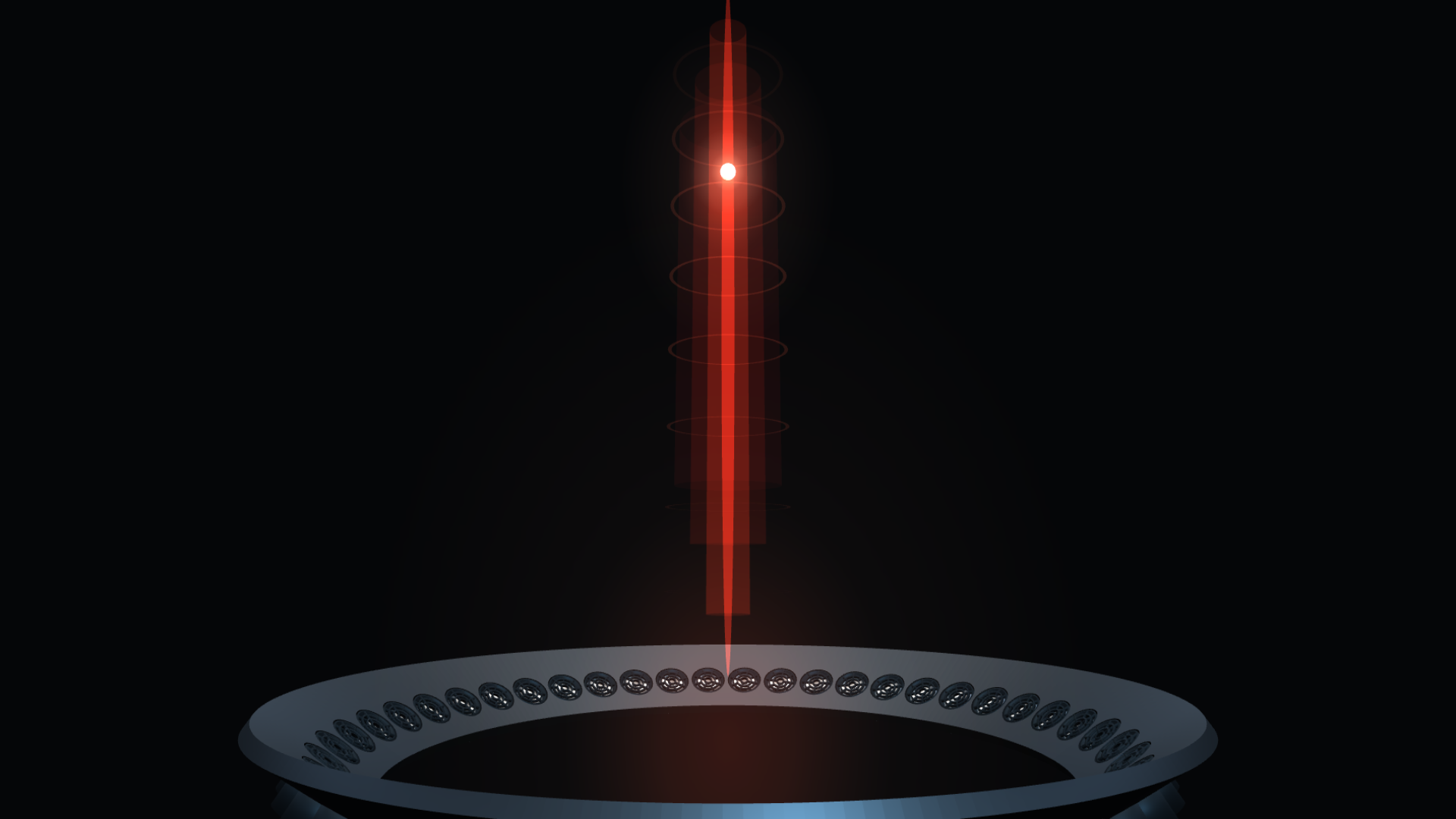
These limitations arise from the underlying trapping mechanism. In conventional acoustic levitation, objects are typically confined at low-pressure nodes surrounded by high-pressure regions. In single-sided systems, however, the restoring force that stabilizes the object decreases with increasing distance from the sound source and eventually becomes repulsive, thereby preventing long-range levitation. In the present study, the researchers employed a zero-order Bessel beam—an ultrasonic beam that maintains a narrow, high-intensity central core over long distances. By exploiting its unique properties, they successfully trapped objects directly within the beam’s high-pressure core using ultrasound emitted from only one side. Using this approach, they achieved stable levitation of a 1.5-mm-diameter expanded polystyrene sphere at distances of up to approximately 40 cm from the sound source—approximately six times farther than those achieved using conventional single-sided acoustic traps. The levitated object could also be manipulated in three dimensions using ultrasound from only one side. Furthermore, the researchers demonstrated the levitation of multiple objects, non-spherical objects, and objects located beyond physical obstacles.
Although acoustic levitation within a high-pressure region had previously been predicted theoretically, this study provides the first experimental demonstration of stable three-dimensional acoustic levitation under such conditions. Because it enables long-range, non-contact manipulation in open, unconfined environments, the method is expected to find applications in automated experimentation and three-dimensional displays.
Yusuke Koroyasu, Christopher Stone, Yoichi Ochiai, Takayuki Hoshi, Bruce W. Drinkwater, Tatsuki Fushimi
頃安祐輔 / Christopher Stone / 落合陽一 / 星貴之 / Bruce W. Drinkwater / 伏見龍樹
Paper : Yusuke Koroyasu, Christopher Stone, Yoichi Ochiai, Takayuki Hoshi, Bruce W. Drinkwater, and Tatsuki Fushimi. Midair Single-Sided Acoustic Levitation in High-Pressure Regions of Zero-Order Bessel Beams. Physical Review Letters 137, 094001 (2026). DOI : 10.1103/pfkh-4x7j
Contact / 連絡先 : tfushimi@slis.tsukuba.ac.jp / koroyu@digitalnature.slis.tsukuba.ac.jp