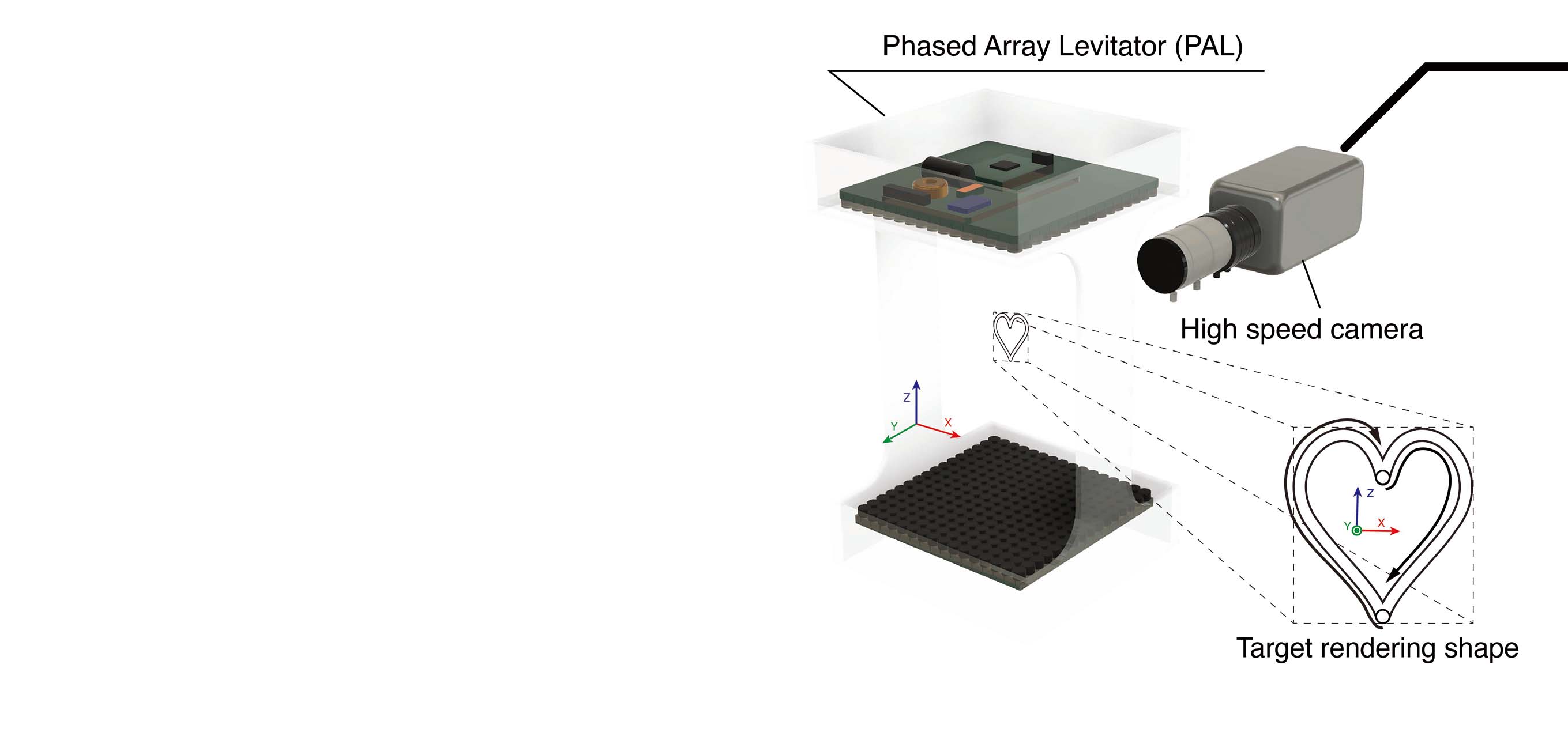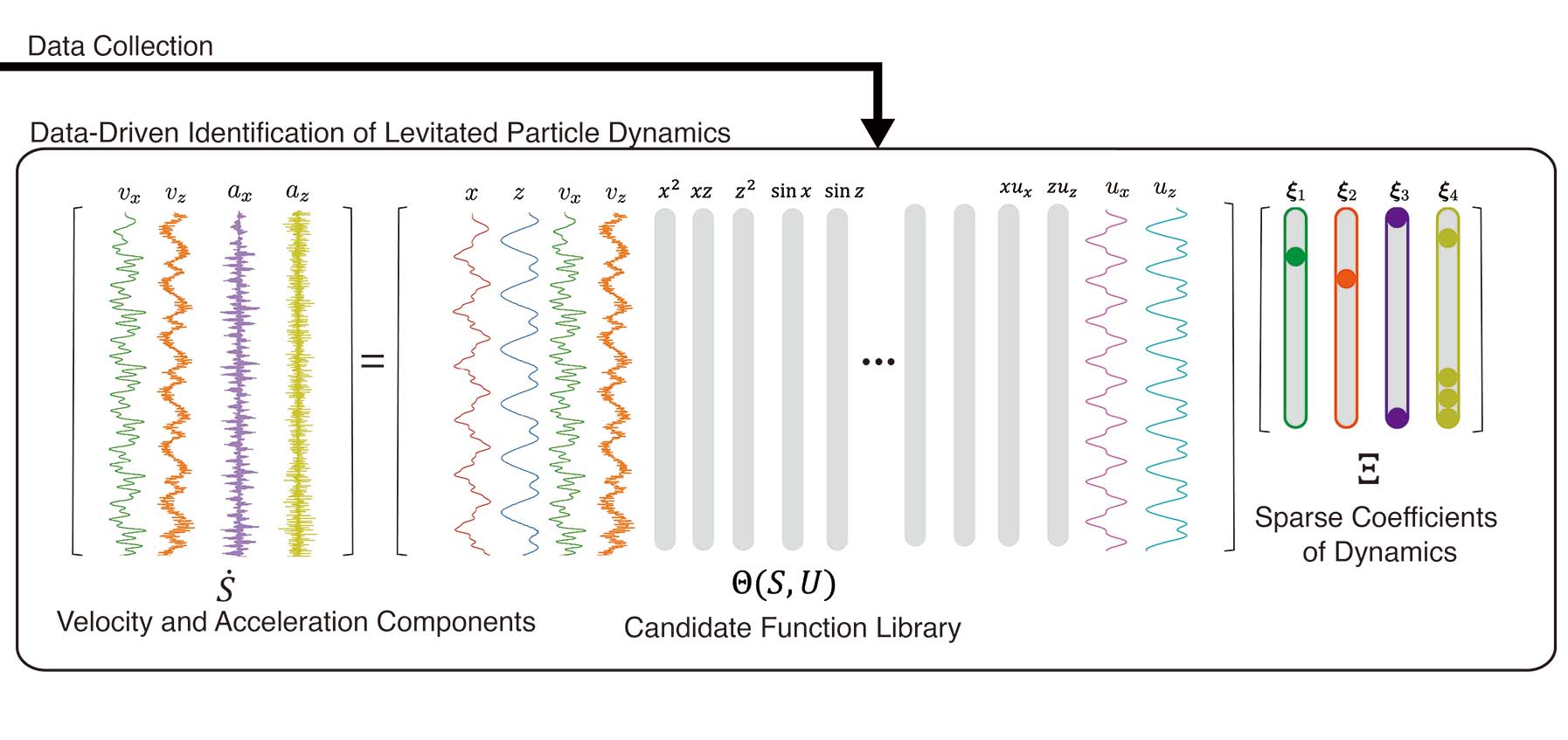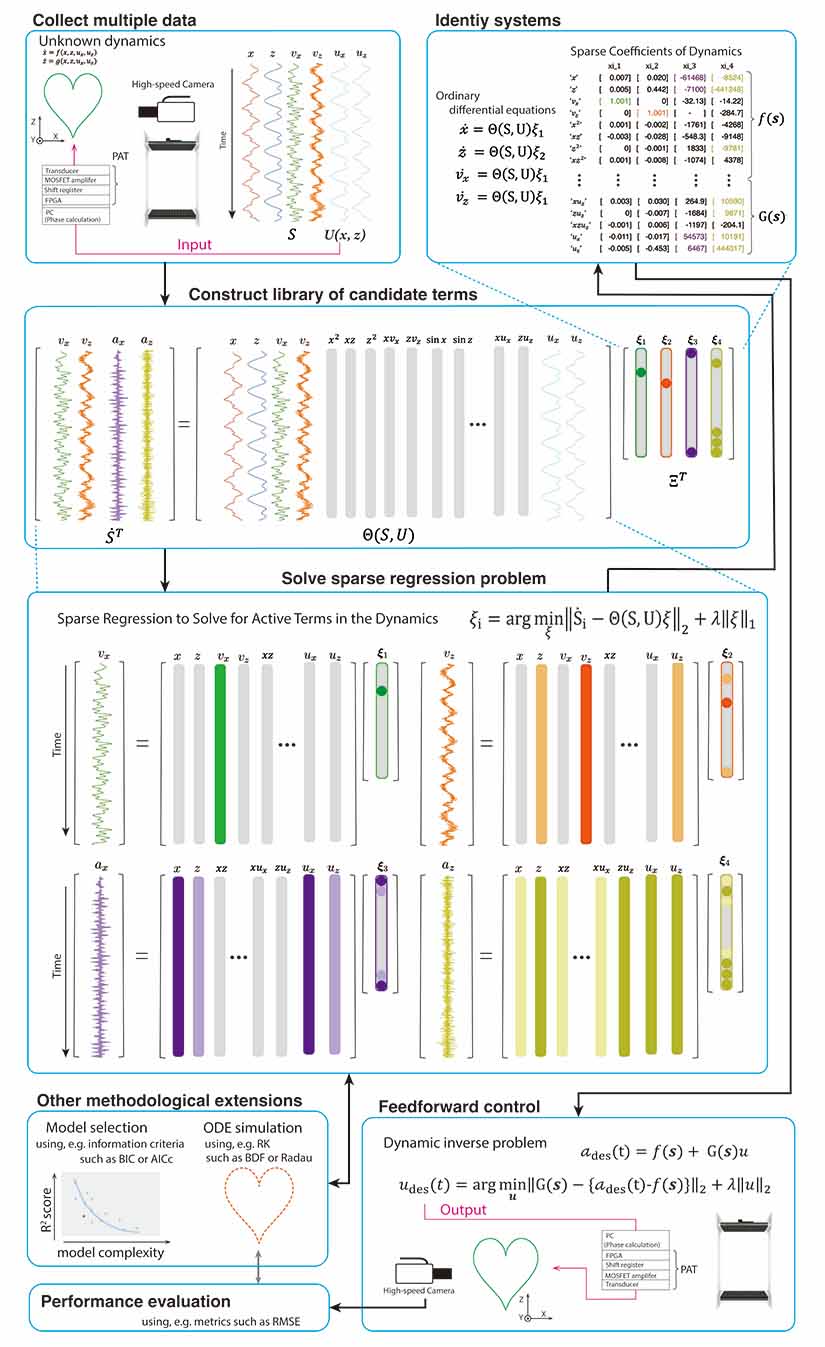
An ultrasonic phased array can drive a particle-scanning display by translating the center of an acoustic trap to move a levitated particle and thereby present free-space graphics via persistence of vision. In practical systems, however, the particle exhibits transient dynamics that introduce systematic distortions—such as lag relative to the commanded trajectory and corner rounding—thus limiting rendering fidelity. In this study, we identified a continuous-time, input-inclusive model using SINDYc from paired measurements of the particle’s 2D motion (captured with a high-speed camera) and the commanded trap-center trajectory. Using periodic scanning data of multiple trajectory shapes, we applied sparse regression to a candidate-function library constructed from the state (position and velocity) and the input, yielding a model that describes the particle’s acceleration dynamics. Validation showed that numerical integration of the identified model reproduces not only smooth trajectories but also the characteristic distortion trends observed for trajectories with sharp turns and self-intersections. Furthermore, we generated feedforward control inputs by solving a model-based dynamic inverse problem and applied them to an unseen trajectory, confirming a reduction in tracking error.
超音波フェーズドアレイを用いた粒子走査型表示では,音響トラップ中心を走査して浮揚粒子を移動させることで空中に図形を提示できる.しかし実機では,粒子の過渡応答により指令軌道に対する遅れや角部の丸まりなどの系統的な歪みが生じ,描画精度が制限される.本研究では,高速度カメラで計測した粒子の2次元運動とトラップ中心指令の対応データから,入力を含む連続時間モデルを SINDYc により同定した.同定では,複数形状の周期走査データを用い,状態(位置・速度)と入力から構成した候補関数ライブラリに対して疎回帰を適用し,加速度ダイナミクスを表すモデルを得た.検証では,同定モデルの数値積分軌道が,滑らかな軌道だけでなく急な角度変化や自己交差を含む軌道においても,観測と同方向の歪み傾向を再現することを確認した.さらに,同定モデルに基づく動的逆問題からフィードフォワード制御入力を生成し,未学習の軌道に適用した結果,追従誤差の低減を確認した.