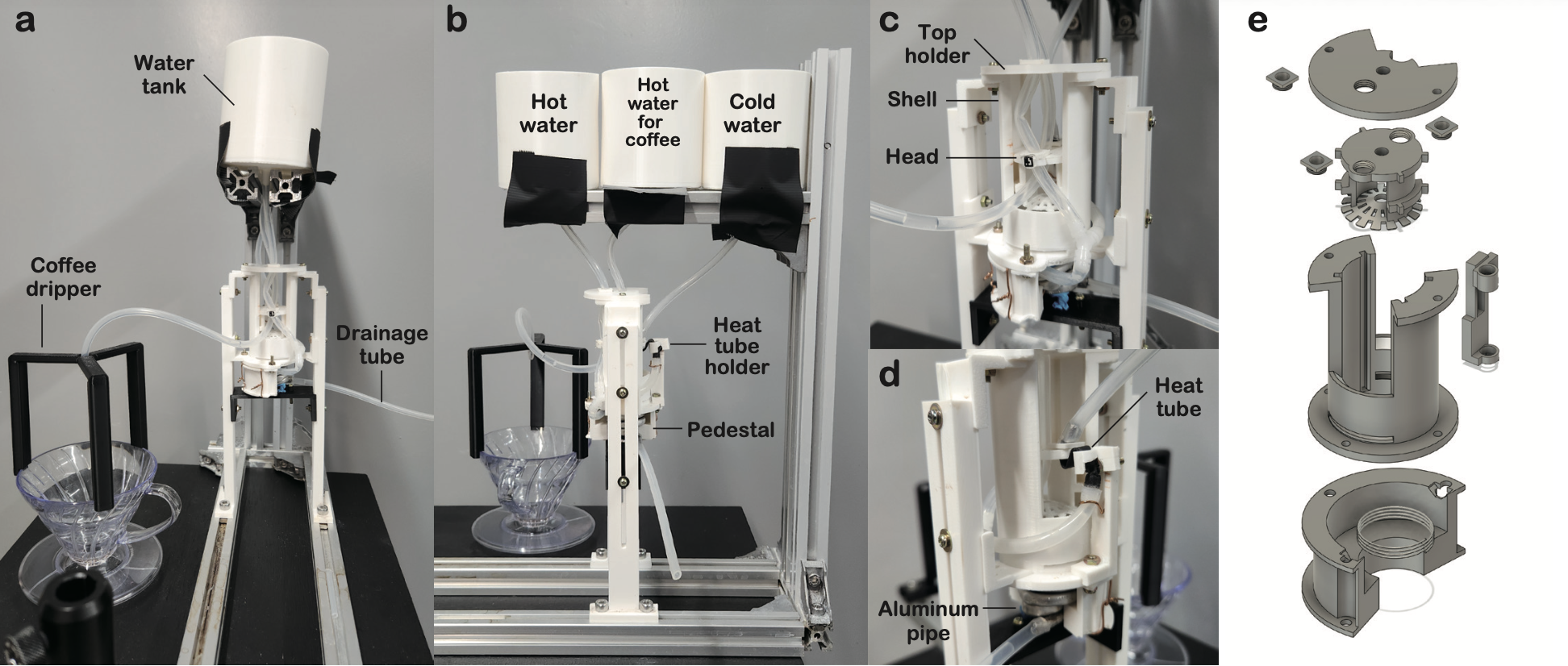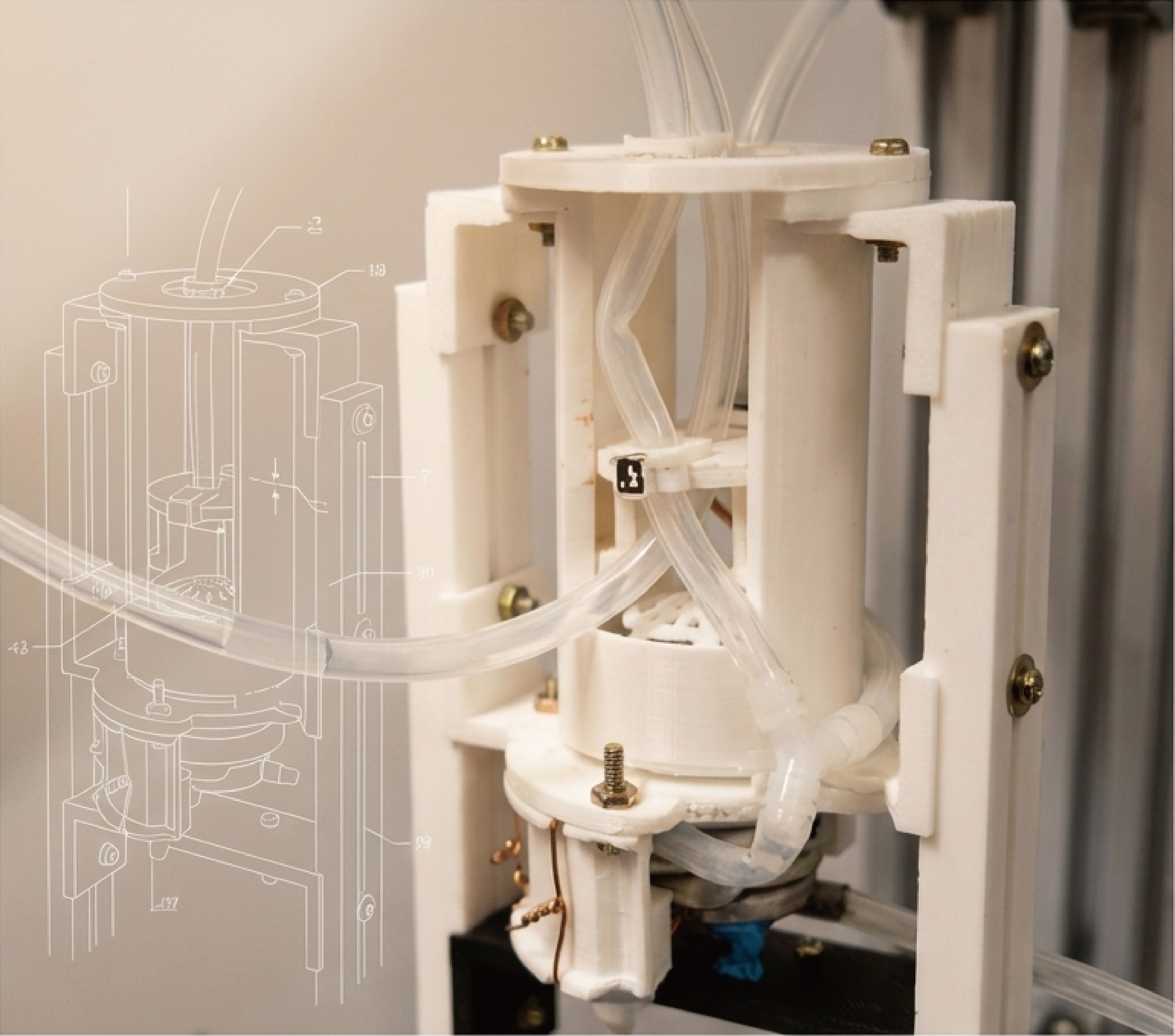
Manual pour-over (paper-filtered) coffee can bring out a high-quality flavor by finely controlling the hot-water flow rate and timing (intermittent pouring). However, this operation requires sustained user attention (Attention Lock) and skill. Existing automatic coffee makers rely on pumps and electrical power, which introduce issues such as operating noise, complex cleaning, and limited installation space, creating barriers to casual use both in the home and in outdoor environments. To address these challenges, this thesis proposes an autonomous, thermally driven soft valve and its application to a coffee brewing system that operates without any external power source, driven solely by the thermal energy of boiling water, which is indispensable for brewing.
The proposed mechanism functions as an oscillator that repeatedly opens and closes as long as heat input is supplied. It utilizes pressure changes associated with the liquid–gas phase transition of a low-boiling-point liquid (n-Pentane) and the nonlinear restoring force arising from the buckling (kinking) of a silicone tube. The food flow path and the drive flow path are physically separated, and the food-contact components are designed to be replaceable and washable. This architecture ensures high hygiene and easy cleaning in domestic settings.
In the engineering evaluation, it was demonstrated that the oscillation frequency and flow rate of the valve can be controlled by adjusting the heat-source temperature and the geometric parameters of the system (tube dimensions and gap length). Furthermore, coffee brewing experiments were conducted as a practical evaluation. The results showed that our system produces a significant change in TDS (total dissolved solids) when varying the pouring rate during brewing.
In addition, component analysis using gas chromatography–mass spectrometry (GC–MS) revealed that control of the pouring rate influences the composition of volatile compounds. Specifically, slow pulsed pouring increased the brew ratio of low-polarity components associated with smoky and spicy notes, and produced a flavor profile distinct from that obtained under fast pulsed pouring.
This thesis scales the oscillatory valve structures of soft robotics to the domain of coffee brewing devices and presents an application that enables both automation of brewing and direct intervention in flavor formation.
提案機構は、低沸点流体の気液相変化に伴う圧力変化と、シリコンチューブの座屈(キンク)現象による非線形ばね力を利用し、熱入力がある限り自励的に開閉を繰り返す発振器として機能する。食品流路と駆動流路を物理的に分離し、食品接触部は交換・洗浄可能な構造としたことで、高い衛生性と家庭における清掃容易性を確保した。
工学的評価において、熱源温度および装置の幾何パラメータ(チューブ寸法、ギャップ長)によって、バルブの発振周波数と流量を制御可能であることを実証した。さらに、実用性評価としてコーヒー抽出実験を行った結果、本機構による断続注湯(パルスドリップ)が、連続注湯と比較してTDS(総溶解固形分)に有意な変化をもたらすことを確認した。加えて、ガスクロマトグラフィー質量分析(GC-MS)を用いた成分分析により、注湯速度の制御が揮発性成分の組成に影響を与えることを明らかにした。具体的には、低速なパルス注湯(Slow条件)は低極性成分(スモーキー、スパイス香など)の抽出割合を増加させ、高速なパルス注湯(Fast条件)とは異なるフレーバープロファイルを形成することが示された。
本研究は、ソフトロボティクスの発振・弁構造をコーヒー抽出器具へスケール化し、抽出の自動化と味覚への介入を可能にするアプリケーションである。