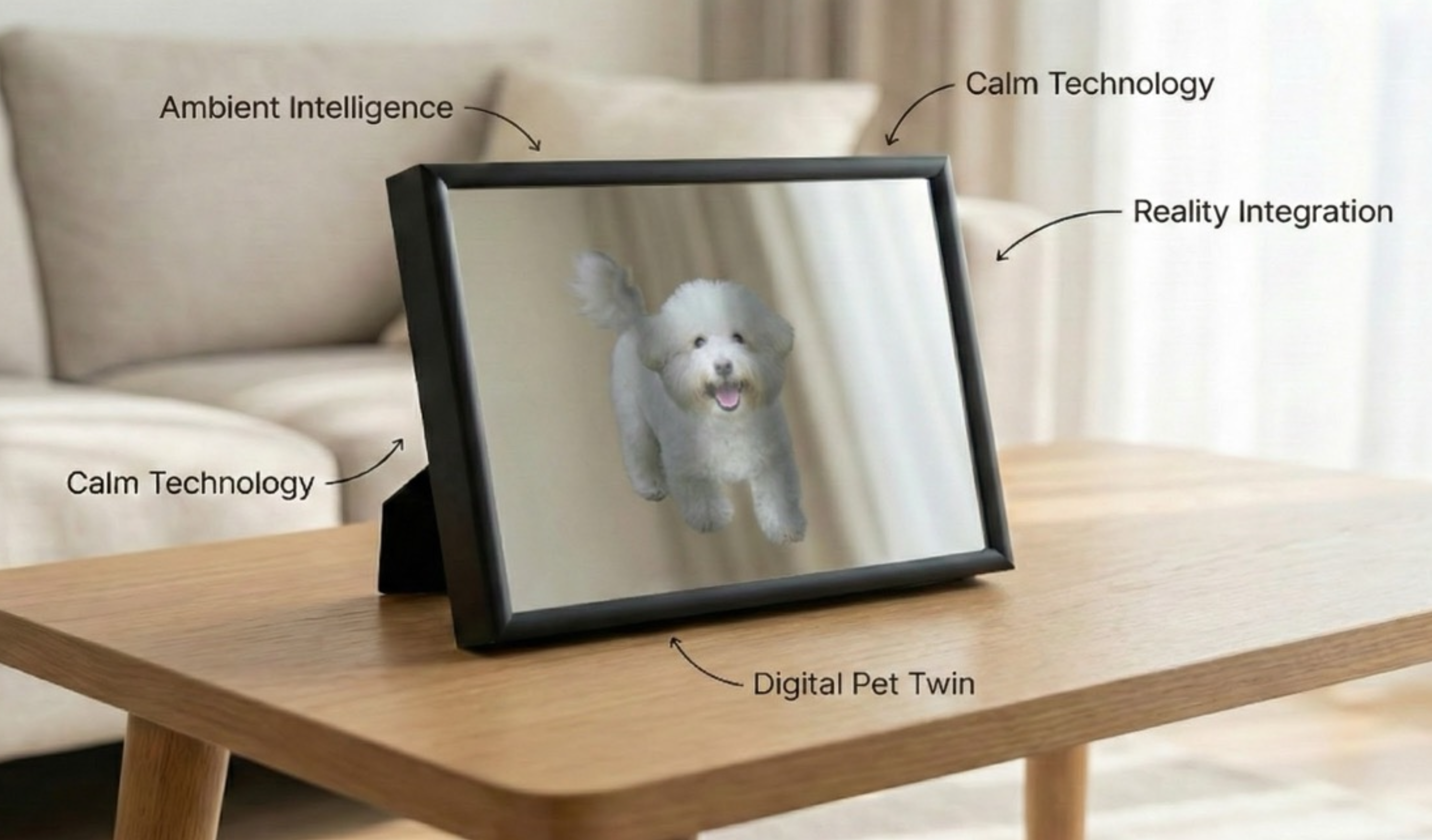
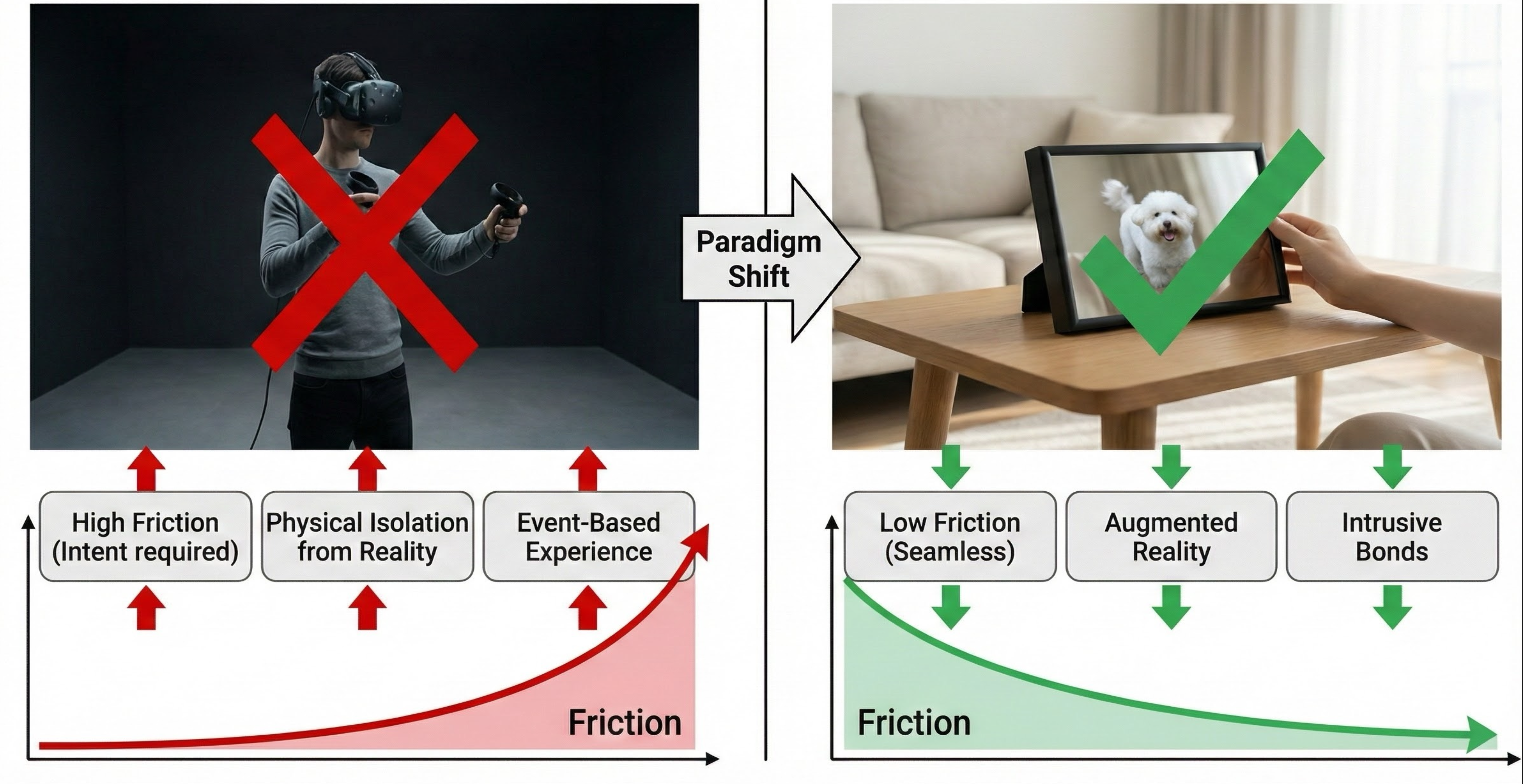
The death of a companion animal precipitates a rupture in the owner’s “extended self,” often leading to Disenfranchised Grief. While digital interventions exist, they currently face a structural trilemma: Virtual Reality (VR) imposes physical isolation, conversational AI creates uncanny anthropomorphism, and real-time generative models risk latency and traumatic hallucinations. To address these limitations, this thesis proposes the ’Magic Pet Mirror,’ a liminal interface designed to facilitate Ambient Continuing Bonds within the domestic ecology.
Technically, the system introduces a novel Retrieval-Augmented Visual Generation (RA-VG) architecture. Departing from the instability of real-time diffusion, RA-VG utilizes a pre-curated library of high-fidelity video primitives, functioning as an “Ethical Firewall” that prevents algorithmic hallucinations while ensuring ethological validity. By leveraging a multimodal Large Language Model (LLM) as an “Ambient Empathy Engine,” the system achieves a response latency of approximately 2.1 seconds―aligning with biological turn-taking ―and enforces “Visual Silence” (non-verbal agency) to bypass the Uncanny Valley. Further- more, a Software-Defined Optical Masking technique is applied to blend the digital entity seamlessly into the user’s physical reflection on consumer hardware.
To evaluate the system’s efficacy, a 7-day in-the-wild study (N = 5) was conducted in an “Analogous Loss” setting. A mixed-methods analysis revealed that the system successfully functioned as a digital “Secure Base,” Substantially normalizing negative affect (∆N A=−3.2). Crucially, phenomenological inquiry identified the phenomenon of “Algorithmic Forgiveness,” where users prioritized the system’s emotional congruence over graphical perfection, accepting the optical illusion as a valid form of co-presence. Finally, addressing the risks of digital dependency, this study proposes a “Gradual Graduation Protocol,” creating a framework where ambient intelligence mediates the transition from acute grief to narrative acceptance.
Hyeonkang Kim, Yoichi Ochiai,Jingjing Li
コンパニオンアニマルの死は、飼い主の「拡張自己(Extended Self)」の崩壊を招き、しばしば「公認されない悲嘆(Disenfranchised Grief)」を引き起こす。この問題に対しデジタルな介入手法は存在するものの、それらは現在、構造的なトリレンマに直面している。すなわち、VR(仮想現実)は物理的な孤立を強いてしまい、会話型AIは不気味な擬人化(Uncanny Anthropomorphism)を生み出し、リアルタイム生成モデルは遅延やトラウマ的なハルシネーション(幻覚)のリスクを孕んでいるのである。これらの限界に対処するため、本論文では、家庭内の生態系においてアンビエントな「継続する絆(Continuing Bonds)」を促進するために設計されたリミナル(境界的)・インターフェース、「Magic Pet Mirror」を提案する。
技術的な側面において、本システムは新規性のある「検索拡張視覚生成(Retrieval-Augmented Visual Generation: RA-VG)」アーキテクチャを導入している。RA-VGは、リアルタイム拡散モデルの不安定さから脱却し、事前に厳選された高精細な映像プリミティブ(基本素材)のライブラリを利用する。これは「倫理的ファイアウォール」として機能し、アルゴリズムによるハルシネーションを防ぎつつ、動物行動学的な妥当性を保証するものである。さらに、「アンビエント・エンパシー・エンジン」としてマルチモーダル大規模言語モデル(LLM)を活用することで、生物学的なターン・テイキング(やり取りの間隔)に適した約2.1秒の応答速度を実現するとともに、「不気味の谷」を回避するために「視覚的な沈黙(Visual Silence)」(非言語的な主体性)を徹底している。加えて、民生用ハードウェア上でデジタルエンティティをユーザーの鏡像にシームレスに融合させるため、「ソフトウェア定義の光学的マスキング」技術が適用されている。
システムの有効性を評価するため、「類似喪失(Analogous Loss)」の設定において、7日間の実環境スタディ(N=5)を実施した。混合研究法による分析の結果、本システムはデジタルの「安全基地(Secure Base)」として機能し、負の感情(Negative Affect)を大幅に正常化(軽減)(∆NA = -3.2)させたことが明らかになった。特筆すべきは、現象学的調査によって「アルゴリズム的許し(Algorithmic Forgiveness)」という現象が確認されたことである。これは、ユーザーがグラフィックの完璧さよりもシステムの感情的な適合性を優先し、光学的イリュージョンを共同存在(Co-presence)の有効な形態として受け入れたことを示している。最後に、デジタル依存のリスクに対処するため、本研究では「段階的卒業プロトコル(Gradual Graduation Protocol)」を提案する。これは、アンビエント・インテリジェンスが、急性期の悲嘆から物語的な受容(Narrative Acceptance)への移行を媒介するフレームワークを構築するものである。